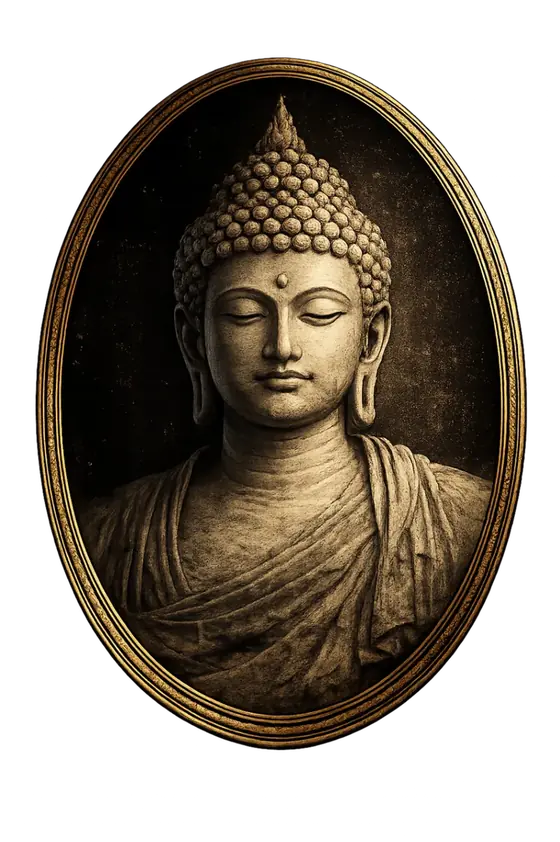
Buddhism
Siddhārtha Gautama
The Awakened One
- Born
- c. 563 BCE
- Died
- c. 483 BCE
- Region
- Ancient India — Kapilavastu
- Vocation
- Prince, ascetic, teacher
A prince who left a palace to understand suffering, and returned with a diagnosis of the human condition and a path through it.
Life
Born into the Shakya clan in the foothills of the Himalayas, Siddhārtha was raised inside a palace deliberately shielded from the reality of aging, sickness, and death. His father, hoping to keep him from a prophecy that he would become a spiritual seeker, gave him every pleasure a life could hold.
At twenty-nine, he saw beyond the walls for the first time. He saw an old man, a sick man, a corpse, and a wandering ascetic. That night, he left his wife, his son, and his kingdom, and disappeared into the forest.
For six years he practiced extreme asceticism, nearly starving to death. He rejected it. Sitting beneath a fig tree at Bodh Gaya, he resolved not to rise until he understood. On the morning of the sixth day, he did.
For the next forty-five years, he walked northern India teaching a middle path — neither indulgence nor deprivation — grounded in what he called the Four Noble Truths.
Core Themes
Timeline
c. 563 BCE
Born a prince
In Lumbini, at the foot of the Himalayas.
age 16
Marries Yasodhara
Sheltered in luxury inside his father's palace.
age 29
The Four Sights
Old age, sickness, death, and a wandering monk.
age 29
The Great Renunciation
Leaves palace, family, and title in the night.
ages 29–35
Years of ascetic search
Studies with sages, then finds the Middle Way.
age 35
Awakening at Bodh Gaya
Beneath the Bodhi tree.
age 35
First sermon at Sarnath
Turns the wheel of the Dharma to five ascetics.
age 80
Parinirvana
Passes away in Kushinagar.
Places
The map of a life — ancient and modern.
Shakya kingdom
Lumbini
Today: Nepal
His birthplace, now a UNESCO site.
Magadha
Bodh Gaya
Today: Bihar, India
The site of his awakening.
Deer Park
Sarnath
Today: Uttar Pradesh, India
Where he first taught the Dharma.
Malla republic
Kushinagar
Today: Uttar Pradesh, India
Where he passed into parinirvana.
Major Works
Verse collection
The Dhammapada
423 verses attributed to the Buddha — a distilled compass for the mind.
Premium unlock · free online edition available
Discourses
The Pali Canon
The earliest complete collection of the Buddha's teachings.
Premium unlock · free online edition available
Voices of the Guide
"You yourself, as much as anybody in the entire universe, deserve your love and affection.
"Peace comes from within. Do not seek it without.
"The mind is everything. What you think, you become.
"Holding on to anger is like grasping a hot coal.
Influence
Influenced by
- Vedic tradition
- Śramaṇa movements
- Jain thought
Who they influenced
- All schools of Buddhism
- Hindu Bhakti movements
- Modern mindfulness
- Cognitive therapy
Modern Impact
Why this guide still matters today.
- Psychology: mindfulness-based stress reduction, ACT, and DBT trace directly to his methods.
- Neuroscience: contemplative research on attention and compassion.
- Leadership: 'beginner's mind' as a management practice.
Related Council Members

Legacy
One man's questions about suffering became the operating system for half a continent — and, twenty-five centuries later, the vocabulary of modern mental health.