Classical Greek Philosophy
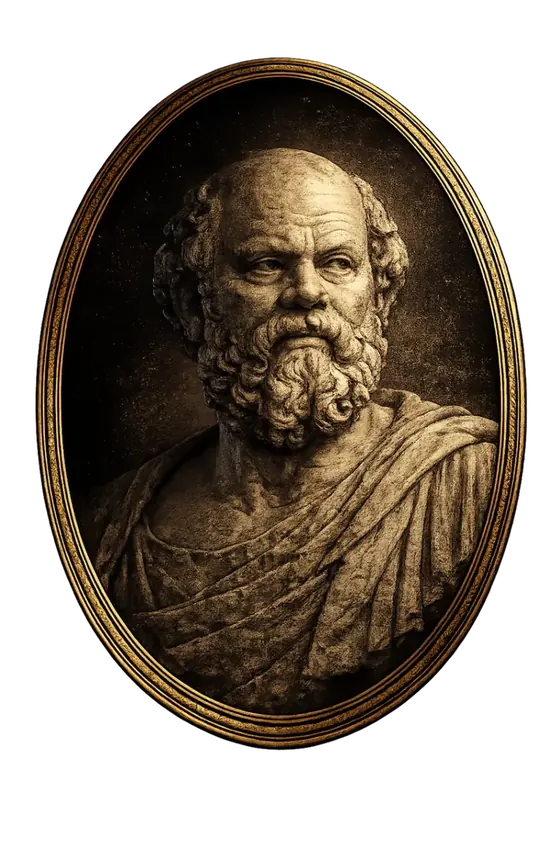
Socrates
The Questioner
- Born
- c. 470 BCE
- Died
- 399 BCE
- Region
- Athens, Ancient Greece
- Vocation
- Philosopher, stonemason, soldier
The father of Western philosophy taught nothing — he only asked. And in his questions, an entire civilization learned to think.
Life
Socrates was the son of a stonemason and a midwife. He served as a hoplite in three campaigns, was known for extraordinary physical endurance, and spent most of his life in the agora of Athens, engaging anyone who would talk with him.
He wrote nothing. Everything we know of him comes through others — chiefly his student Plato. He claimed to know only one thing: that he knew nothing.
At seventy, Athens tried him for corrupting the youth and impiety. Offered exile, he refused. He drank hemlock surrounded by his students and, according to Plato, spent his final hours arguing that the philosopher should not fear death.
Core Themes
Timeline
c. 470 BCE
Born in Athens
Into the deme of Alopece, son of a stonemason and midwife.
432 BCE
Battle of Potidaea
Serves with distinction as a hoplite; saves Alcibiades.
424 BCE
Battle of Delium
Renowned for calm bravery during the Athenian retreat.
adult life
Philosophy in the agora
Questions citizens, sophists, and politicians.
406 BCE
Defies the Assembly
As presiding officer, refuses to hold an unlawful mass trial.
399 BCE
Trial for impiety
Accused of corrupting the youth of Athens.
399 BCE
Death by hemlock
Refuses exile and dies among his students.
Places
The map of a life — ancient and modern.
Athenian polis
Athens
Today: Athens, Greece
His entire life unfolded here.
Marketplace
The Agora
Today: Ancient Agora, Athens
Where he taught by asking.
Major Works
Dialogue
The Apology (via Plato)
His defense speech at trial — a manifesto for the examined life.
Premium unlock · free online edition available
Dialogue
The Symposium (via Plato)
On the nature of love.
Premium unlock · free online edition available
Voices of the Guide
"The unexamined life is not worth living.
"I know that I know nothing.
"There is only one good: knowledge. And one evil: ignorance.
"The secret of happiness is not found in seeking more, but in developing the capacity to enjoy less.
Influence
Influenced by
- Presocratics
- The sophists (in opposition)
Who they influenced
- Plato
- Aristotle
- All Western philosophy
- Christian theology
- Modern therapy
Modern Impact
Why this guide still matters today.
- Education: the Socratic method underpins modern law schools and coaching.
- Therapy: cognitive-behavioral therapy uses Socratic questioning as its core technique.
- Democracy: the citizen who examines their own beliefs is the citizen democracy requires.
Related Council Members
Legacy
Every time a teacher asks 'why do you think that?' instead of giving an answer, Socrates is in the room.