Depth Psychology
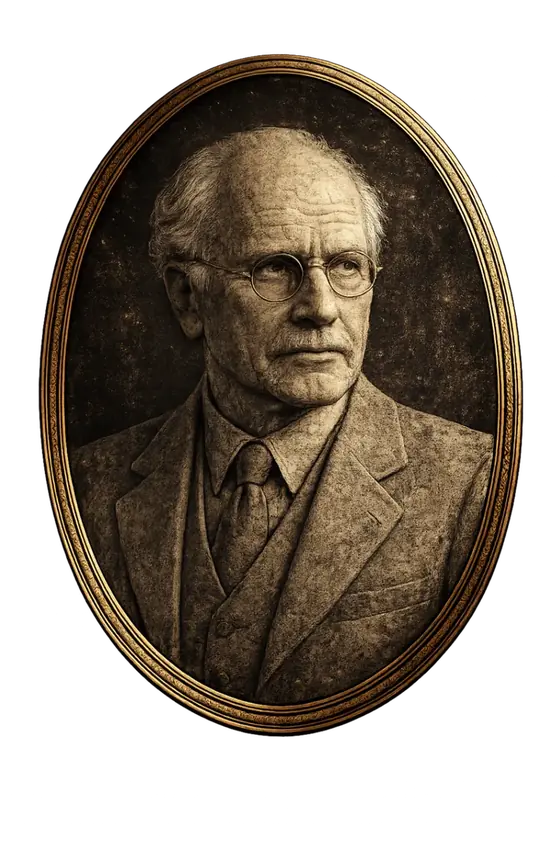
Carl Gustav Jung
The Cartographer of the Soul
- Born
- 1875 CE
- Died
- 1961 CE
- Region
- Switzerland
- Vocation
- Psychiatrist, psychologist
The Swiss psychiatrist who insisted the modern mind still contained the ancient soul, and gave us the vocabulary — archetype, shadow, individuation — to speak of it.
Life
Jung was the son of a Swiss Reformed pastor. He trained under Freud, was for a time his heir apparent, and then broke with him over the nature of the unconscious.
For Freud, the unconscious was largely a basement of repressed sexuality. For Jung, it was a vast, collective inheritance — the accumulated symbols and stories of humanity, alive in every dream and mythology.
He spent his life mapping this interior country. His concepts — the shadow, the anima, the archetypes, individuation — have become the language in which modern people speak about themselves.
Core Themes
Timeline
1875
Born in Kesswil
Switzerland, to a pastor of the Swiss Reformed Church.
1900
Begins psychiatric work at Burghölzli
Under Eugen Bleuler in Zurich; studies word association.
1907
Meets Freud
A five-year collaboration begins; Freud calls him his 'heir'.
1913
Breaks with Freud
Enters his 'confrontation with the unconscious' — the Red Book years.
1921
Publishes Psychological Types
Introduces introversion, extraversion, and the four functions.
1944
Near-death vision
A cardiac event brings profound visions that shape his late work.
1951
Publishes Aion
His mature synthesis of the Self, the shadow, and Christian symbolism.
1961
Dies at Küsnacht
At his home on Lake Zurich, aged 85.
Places
The map of a life — ancient and modern.
—
Küsnacht
Today: Switzerland
His home and consulting room for decades.
—
Bollingen Tower
Today: Switzerland
The stone retreat he built with his own hands.
Major Works
Book · 1964
Man and His Symbols
His accessible introduction to the psyche.
No free public edition found yet
Illuminated manuscript · 1914–1930
The Red Book
The private record of his descent into the unconscious.
No free public edition found yet
Autobiography · 1962
Memories, Dreams, Reflections
His life as a spiritual document.
No free public edition found yet
Voices of the Guide
"Who looks outside, dreams; who looks inside, awakes.
"Until you make the unconscious conscious, it will direct your life and you will call it fate.
"The privilege of a lifetime is to become who you truly are.
"There is no coming to consciousness without pain.
Influence
Influenced by
- Freud
- Nietzsche
- Gnosticism
- Eastern philosophy
Who they influenced
- Modern psychology
- Joseph Campbell
- 12-step programs
- Contemporary spirituality
Modern Impact
Why this guide still matters today.
- Psychology: the concepts of introvert, extrovert, shadow, and archetype are his.
- Story: modern screenwriting rests on the Hero's Journey, which rests on Jung.
Related Council Members
Legacy
Every time you hear someone talk about their 'shadow work,' Jung is present. He gave the modern West the map back to its own interior.