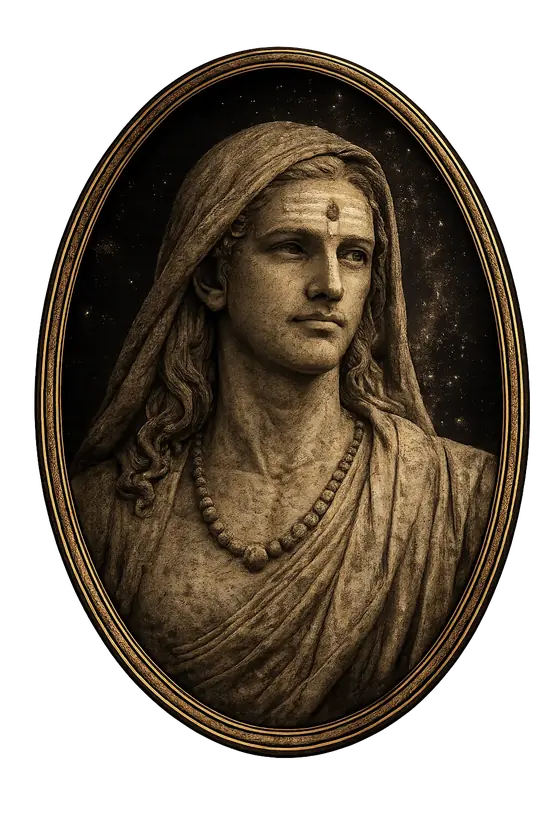
Advaita Vedanta
Adi Shankara
The Non-Dual Sage
- Born
- c. 788 CE
- Died
- c. 820 CE
- Region
- Kerala, India
- Vocation
- Philosopher, monk, teacher
In a life of barely thirty years, Shankara walked the length of India, debated the era's greatest scholars, and set down the definitive statement of non-dual Vedanta.
Life
Born to a Nambudiri Brahmin family in Kerala, Shankara took sannyasa (renunciation) as a boy. He walked north to the Narmada, found his teacher Govinda Bhagavatpada, and began composing his commentaries in his teens.
He founded four monastic seats at the corners of India — Sringeri, Dwarka, Puri, and Jyotirmath — and revitalized the recitation of the Upanishads. He died at Kedarnath in the Himalayas, having, by tradition, completed his work by thirty-two.
Core Themes
Timeline
c. 788
Born in Kaladi
In present-day Kerala, to a devout Brahmin family.
c. 796
Renunciation
Takes sannyasa as a boy, with his mother's reluctant blessing.
c. 800
Meets Govinda
Finds his guru on the banks of the Narmada river.
early 800s
The Commentaries
Composes the bhashyas on the Upanishads, Bhagavad Gita, and Brahma Sutras.
mid 800s
Debates across India
Debates Mandana Mishra and other scholars; establishes non-dualism as the dominant reading.
later years
Four monasteries
Founds mathas at the cardinal directions to preserve the tradition.
c. 820
Ascent to Kedarnath
Traditionally dies in the Himalayas at thirty-two, his work complete.
Places
The map of a life — ancient and modern.
Kaladi
Kaladi
Today: Kerala, India
The village of his birth.
Sringeri
Sringeri
Today: Karnataka, India
The southern seat of his lineage.
Kedarnath
Kedarnath
Today: Uttarakhand, India
Where the Himalayas received him.
Major Works
Commentary
Brahma Sutra Bhashya
His decisive commentary on the Brahma Sutras, the charter of Vedanta.
No free public edition found yet
Poem
Vivekachudamani
The Crest-Jewel of Discrimination — a practical manual of non-dual realization.
No free public edition found yet
Prose and verse
Upadesha Sahasri
A Thousand Teachings on the direct path of self-inquiry.
No free public edition found yet
Voices of the Guide
"Brahman alone is real; the world is illusory; the individual self is nothing other than Brahman.
"The Self is neither born nor dies. It is not the effect of any cause.
"Do not be attached to the fruit of your action, but do the action.
"Regard others as your own self.
"That thou art.
Influence
Influenced by
- upanishadic sages
- gaudapada
Who they influenced
- ramanuja (in opposition)
- modern Vedanta
Modern Impact
Why this guide still matters today.
- Foundational for Hindu revivalism
- Shaped modern comparative philosophy of consciousness
Related Council Members
Legacy
Shankara left India a single unbroken argument: that the seeker and the sought were never two.