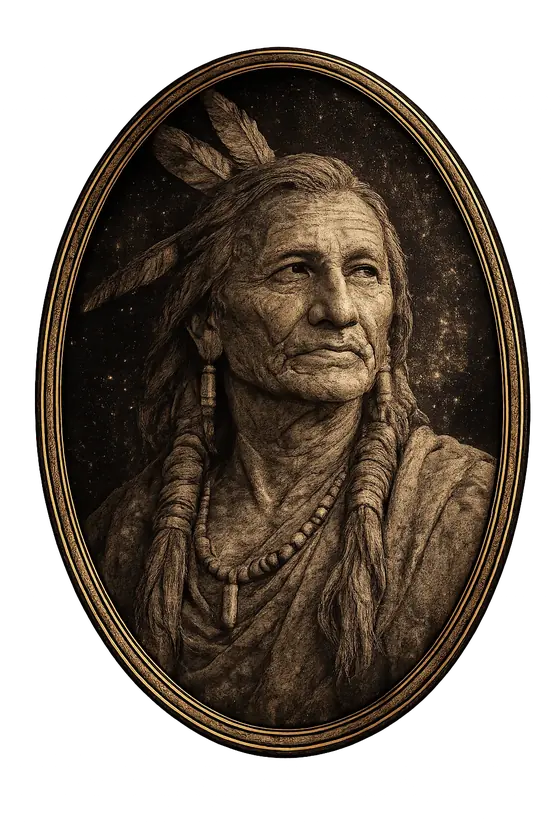
Oglala Lakota Sacred Vision
Black Elk
The Keeper of the Sacred Hoop
- Born
- 1863
- Died
- 1950
- Region
- Northern Plains — Lakota Territory
- Vocation
- Wičháša wakȟáŋ (holy man), healer, visionary
An Oglala Lakota holy man who as a boy received a great vision of the sacred hoop of all peoples, and who spent his long life trying to keep that hoop from breaking.
Life
Born beside the Little Powder River in what is now Wyoming, Black Elk was a second cousin of Crazy Horse and witnessed, as a child, the Battle of the Little Bighorn and, as a young man, the massacre at Wounded Knee. At nine, he was given a vision so vast it took him the rest of his life to interpret it.
He toured Europe with Buffalo Bill, met the queen of England, returned home to a broken people, and worked as a healer and, later, a Catholic catechist — carrying, without contradiction, both the pipe and the cross. His words, recorded by John G. Neihardt in Black Elk Speaks, became one of the twentieth century's most quoted sacred texts.
Core Themes
Timeline
1863
Born by the Little Powder
In the winter the Lakota called 'when the Four Crows were killed.'
1872
The Great Vision
At nine, in a nine-day illness, he receives a vision of the six Grandfathers and the sacred hoop.
1876
Little Bighorn
Witnesses the defeat of Custer as a boy of thirteen.
1887
London
Travels with Buffalo Bill's Wild West; meets Queen Victoria; sees the industrial world firsthand.
1890
Wounded Knee
Present at the massacre; carries its grief the rest of his life.
1904
Baptized Catholic
Takes the name Nicholas Black Elk; works for decades as a catechist without renouncing the Lakota way.
1931
Speaks to Neihardt
Dictates his life and vision to the poet John G. Neihardt at Pine Ridge.
1950
Death at Pine Ridge
Dies in Manderson; witnesses report a display of lights across the night sky.
Places
The map of a life — ancient and modern.
Wazí Aháŋhaŋ Oyáŋke
Pine Ridge
Today: Pine Ridge Reservation, South Dakota, USA
Home of the Oglala Lakota and of Black Elk's later life.
Ȟínháŋ Káǧa (Black Elk Peak)
Harney Peak
Today: Black Hills, South Dakota, USA
The center of the world, as shown in his vision.
Čhaŋkpé Ópi
Wounded Knee
Today: Pine Ridge Reservation, South Dakota, USA
The site of the 1890 massacre, where he said 'the sacred hoop was broken.'
Major Works
As-told-to autobiography · 1932
Black Elk Speaks
Recorded by John G. Neihardt — his life, his vision, and the breaking of the sacred hoop.
No free public edition found yet
Ritual account · 1953
The Sacred Pipe
Recorded by Joseph Epes Brown — the seven rites of the Oglala Lakota, given in his final years.
No free public edition found yet
Voices of the Guide
"I saw that the sacred hoop of my people was one of many hoops that made one circle, wide as daylight and as starlight.
"The center of the world is everywhere.
"Peace comes within the souls of men when they realize their relationship, their oneness, with the universe and all its powers.
"Grown men can learn from very little children, for the hearts of little children are pure.
"It is in the darkness of their eyes that men get lost.
Influence
Influenced by
- the six grandfathers
- crazy horse
- lakota tradition
Who they influenced
- indigenous rights movements
- deep ecology
- modern comparative religion
Modern Impact
Why this guide still matters today.
- Central voice in the twentieth-century recovery of indigenous spiritual traditions
- Foundational reading for ecological, communal, and non-Western ways of knowing
Related Council Members
Legacy
Black Elk lived long enough to see the hoop broken and to insist, until his last night, that a hoop broken is still a hoop, still holy, still able to be mended.