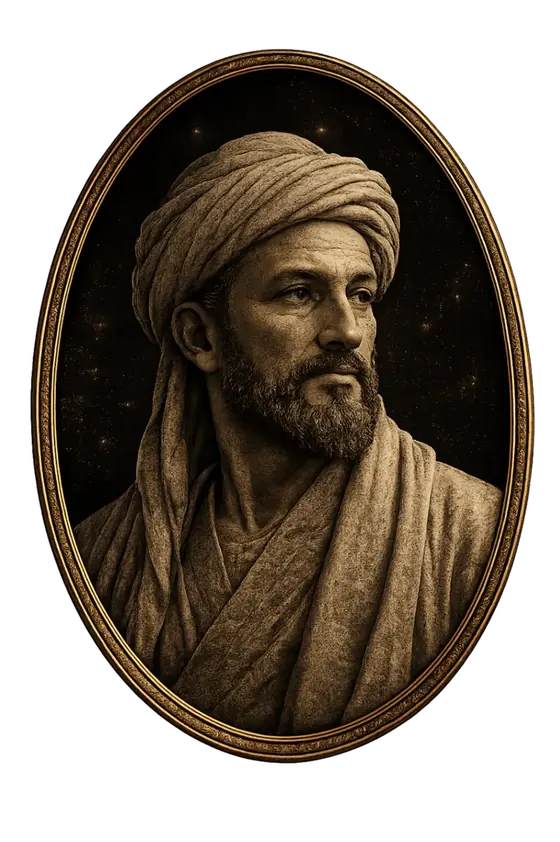
Islamic Golden Age
Ibn Sīnā (Avicenna)
The Physician of Being
- Born
- 980 CE
- Died
- 1037 CE
- Region
- Persia — Bukhara & Isfahan
- Vocation
- Physician, philosopher, polymath
The greatest physician of the medieval world was also its most systematic philosopher — and he did most of it before he turned thirty.
Life
Ibn Sīnā was born near Bukhara in what is now Uzbekistan. By ten he had memorized the Qur'an. By sixteen he was treating patients. By eighteen he had, by his own account, exhausted the sciences of his time.
His medical encyclopedia, the Canon of Medicine, became the standard medical textbook of Europe and the Islamic world for six hundred years.
His philosophy fused Aristotle with Islamic theology, and shaped Aquinas, Duns Scotus, and the entire scholastic tradition.
Core Themes
Timeline
980 CE
Born near Bukhara
In the Samanid empire — a hub of learning.
age 10
Memorizes the Qur'an
Masters grammar, logic, and Indian arithmetic soon after.
age 16
Begins medical practice
Considered a master physician; cures the Samanid emir.
age 18
Access to the royal library
Devours philosophy, astronomy, and medicine in Bukhara.
c. 1015 CE
Composes The Book of Healing
A vast encyclopedia of philosophy and science.
1025 CE
Completes the Canon
The Canon of Medicine — a millennium-defining text.
1037 CE
Dies near Hamadan
Iran — exhausted by travel, court intrigue, and study.
Places
The map of a life — ancient and modern.
Samanid capital
Bukhara
Today: Uzbekistan
His intellectual formation.
Persian city
Isfahan
Today: Iran
Where much of his mature work was written.
Persian city
Hamadan
Today: Iran
Where he died and is buried.
Major Works
Medical encyclopedia · c. 1025
The Canon of Medicine
The standard medical textbook of Europe and the Islamic world for six centuries.
Premium unlock · free online edition available
Philosophical encyclopedia
The Book of Healing
A vast synthesis of logic, physics, metaphysics, and psychology.
No free public edition found yet
Voices of the Guide
"The world is divided into men who have wit and no religion and men who have religion and no wit.
"Medicine considers the human body as to the means by which it is cured and by which it is driven from health.
"The knowledge of anything is not acquired unless one knows its causes.
Influence
Influenced by
- Aristotle
- Al-Farabi
- Galen
Who they influenced
- Aquinas
- Duns Scotus
- European medicine to 1650
- Modern philosophy of mind
Modern Impact
Why this guide still matters today.
- Medicine: systematic diagnosis and integrated body-mind treatment.
- Philosophy of mind: the 'Floating Man' anticipates modern debates on consciousness.
Related Council Members
Legacy
For six centuries, if a European doctor knew anything at all, it was because Ibn Sīnā had written it down first.