Medieval Christian Mysticism
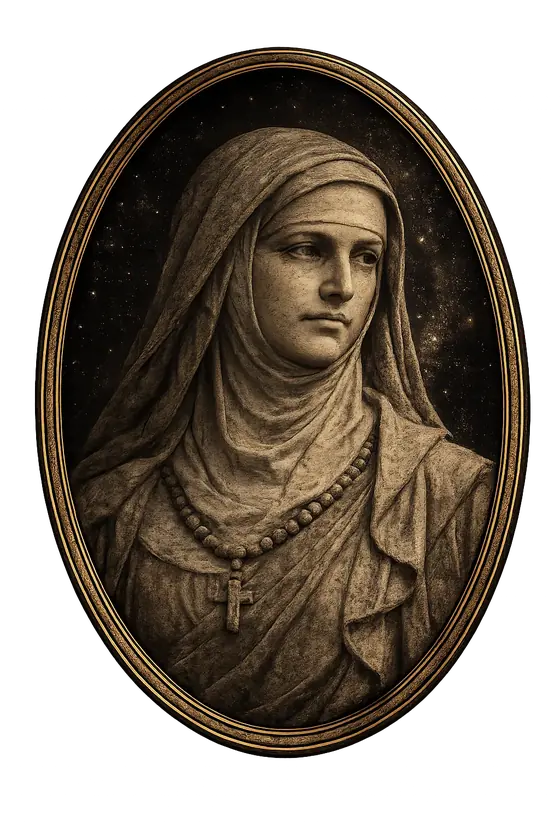
Hildegard of Bingen
The Sibyl of the Rhine
- Born
- 1098
- Died
- 1179
- Region
- Holy Roman Empire — Rhineland
- Vocation
- Abbess, composer, visionary, healer
Benedictine abbess, composer, herbalist, and visionary, Hildegard wrote theology, natural science, and music of extraordinary force in an age that rarely permitted women a voice.
Life
Given to the church as a child, Hildegard grew up in an anchoress's cell attached to the monastery of Disibodenberg. Visions accompanied her from earliest memory, but she kept silent about them until, at forty-two, a 'fiery light' commanded her to write.
She founded her own monastery at Rupertsberg, preached across the Rhineland, corresponded with popes and emperors, composed some of the most soaring monophonic music of the era, and left one of the earliest natural-history compendia by a Western woman.
Core Themes
Timeline
1098
Born in Bermersheim
The tenth child of a minor noble family.
1106
Enclosed at Disibodenberg
Placed under the care of the anchoress Jutta of Sponheim.
1136
Elected magistra
Becomes leader of the women's community after Jutta's death.
1141
The command to write
A vision of living fire opens the scriptures to her; she begins Scivias.
1150
Founds Rupertsberg
Establishes her own monastery near Bingen despite ecclesiastical opposition.
1150s–70s
Music, medicine, preaching
Composes the Symphonia, writes Physica and Causae et Curae, undertakes four preaching tours.
1179
Death at Rupertsberg
Dies with, tradition says, two arcs of light forming a cross in the sky above her cell.
Places
The map of a life — ancient and modern.
Disibodenberg
Disibodenberg
Today: Odernheim am Glan, Germany
The monastery of her childhood enclosure.
Rupertsberg
Rupertsberg
Today: Bingen am Rhein, Germany
Her own foundation, above the confluence of the Nahe and Rhine.
Major Works
Visionary theology · 1141–1151
Scivias
Know the Ways — twenty-six visions of God, cosmos, and salvation history.
No free public edition found yet
Liturgical music
Symphonia armoniae celestium revelationum
Seventy-seven monophonic chants of astonishing melodic reach.
No free public edition found yet
Natural science
Physica
A compendium of plants, stones, animals, and elements, with their healing uses.
No free public edition found yet
Voices of the Guide
"The earth which sustains humanity must not be injured. It must not be destroyed.
"There is the music of Heaven in all things.
"Glance at the sun. See the moon and the stars. Gaze at the beauty of the green earth. Now think.
"Underneath all the texts, all the sacred psalms and canticles, these watery varieties of sounds and silences, terrifying, mysterious, whirling and sometimes gestating and gentle, must somehow be felt in the pulse, ebb, and flow of the music that sings in me.
"I, the fiery life of divine wisdom, I ignite the beauty of the plains.
Influence
Influenced by
- benedict of nursia
- biblical prophets
Who they influenced
- medieval mystics
- modern eco-theology
Modern Impact
Why this guide still matters today.
- Named Doctor of the Church in 2012
- Revered as an early ecological voice
Related Council Members

Legacy
Hildegard offered a mysticism greened with sap — a way of prayer inseparable from the living world.