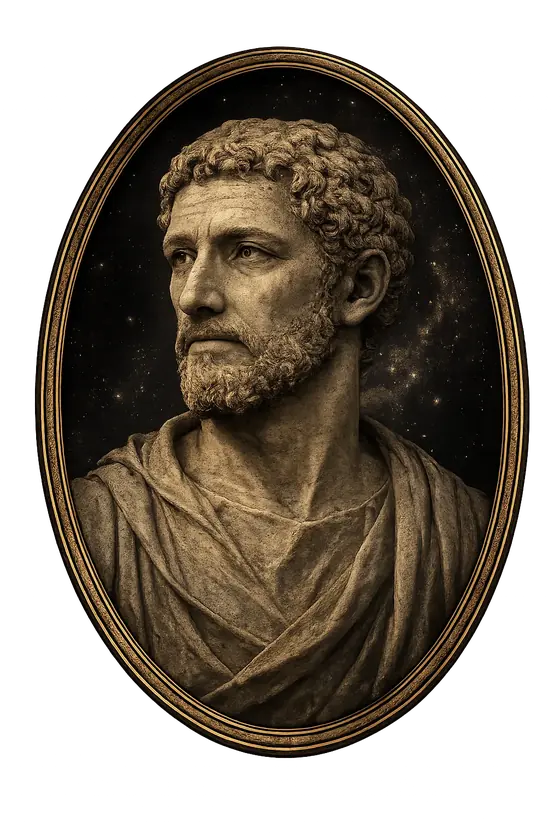
Late Roman Christian Platonism
Boethius
The Consoler of Fortune
- Born
- c. 480 CE
- Died
- c. 524 CE
- Region
- Ostrogothic Kingdom — Italy
- Vocation
- Statesman, philosopher, translator
Awaiting execution on a false charge of treason, Boethius composed The Consolation of Philosophy — a dialogue with Lady Philosophy that became the most influential book of the Middle Ages after the Bible.
Life
Born to a noble Roman family after Rome's fall, Boethius rose to become consul and chief minister to the Ostrogothic king Theoderic. He set himself the task of translating all of Plato and Aristotle into Latin — a bridge between two worlds.
Accused of conspiring with the eastern emperor, he was imprisoned at Pavia. There, in his cell, he wrote the Consolation: a conversation between his grieving self and the figure of Philosophy, who reminds him that fortune's gifts were never truly his.
Core Themes
Timeline
c. 480
Born in Rome
Into the senatorial Anicii family, shortly after the deposition of the last western emperor.
c. 500
Studies philosophy
Trained in Greek learning, likely at Alexandria or Athens.
510
Consul
Appointed sole consul of Rome under Theoderic.
520s
Translation project
Renders Aristotle's logic into Latin — the West's philosophical inheritance for 500 years.
522
Master of Offices
Becomes chief minister; his two sons made joint consuls in the same year.
523
Arrested
Accused of treason and magic; imprisoned without trial at Pavia.
c. 524
The Consolation
Writes his final dialogue in prison; executed shortly after.
Places
The map of a life — ancient and modern.
Roma
Rome
Today: Rome, Italy
His ancestral city, still standing though her empire had fallen.
Ticinum
Pavia
Today: Pavia, Italy
The city of his imprisonment and death.
Major Works
Prose and verse dialogue · c. 524
The Consolation of Philosophy
A prisoner's conversation with Lady Philosophy on fortune, evil, providence, and the highest good.
No free public edition found yet
Theological treatise
On the Trinity
One of the tractates that shaped medieval Christian metaphysics.
No free public edition found yet
Voices of the Guide
"Nothing is miserable unless you think it so.
"Who would give a law to lovers? Love is unto itself a higher law.
"In every ill turn of fortune the most unhappy sort of misfortune is to have been happy.
"If there is a God, whence proceed so many evils? If there is no God, whence cometh any good?
"The good is that at which all things aim.
Influence
Influenced by
- plato
- aristotle
- augustine
Who they influenced
- aquinas
- dante
- chaucer
Modern Impact
Why this guide still matters today.
- Central to medieval and Renaissance thought
- Foundational for consolation as a literary genre
Related Council Members
Legacy
Boethius showed that philosophy is not decoration but a discipline strong enough to hold a soul the night before execution.